



Calcium deposits, commonly known as limescale, are a persistent nuisance in many households and industrial settings. They form when hard water, which contains high levels of calcium and magnesium salts, evaporates, leaving behind these mineral deposits. Over time, limescale can accumulate on various surfaces, including kettles, coffee makers, dishwashers, and pipes, reducing their efficiency and lifespan. As a descaling tablet supplier, I often get asked the question: Can descaling tablets remove calcium deposits? In this blog post, I'll delve into the science behind descaling tablets and their effectiveness in combating limescale.
Understanding Calcium Deposits
Before we explore the effectiveness of descaling tablets, it's important to understand the nature of calcium deposits. Calcium deposits are primarily composed of calcium carbonate, which is insoluble in water. When water containing calcium bicarbonate is heated, the bicarbonate decomposes into carbonate, carbon dioxide, and water. The carbonate then precipitates out of the solution, forming solid deposits on surfaces. These deposits can be hard and stubborn, making them difficult to remove.
How Descaling Tablets Work
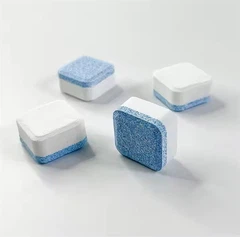
Descaling tablets are formulated with chemicals that react with calcium carbonate to break it down into soluble compounds. The most common active ingredients in descaling tablets are citric acid, acetic acid, and sulfamic acid. These acids work by reacting with the calcium carbonate in the limescale, producing calcium salts that are soluble in water. This allows the limescale to be easily rinsed away.
For example, when citric acid reacts with calcium carbonate, it forms calcium citrate, water, and carbon dioxide. The chemical equation for this reaction is:
2C₆H₈O₇ + 3CaCO₃ → Ca₃(C₆H₅O₇)₂ + 3H₂O + 3CO₂
This reaction effectively dissolves the limescale, making it easier to clean.
Effectiveness of Descaling Tablets
The effectiveness of descaling tablets depends on several factors, including the type and concentration of the active ingredient, the severity of the limescale buildup, and the temperature and duration of the descaling process.
In general, descaling tablets are highly effective at removing light to moderate limescale deposits. For example, in a kettle with a thin layer of limescale, a descaling tablet can often completely remove the deposits in a single treatment. However, for more severe limescale buildup, multiple treatments may be required.
It's also important to note that the effectiveness of descaling tablets can be enhanced by following the manufacturer's instructions carefully. This includes using the correct number of tablets, dissolving them in the appropriate amount of water, and allowing the solution to soak for the recommended time.
Advantages of Using Descaling Tablets
There are several advantages to using descaling tablets to remove calcium deposits:
- Convenience: Descaling tablets are easy to use. Simply drop a tablet into the appliance or container filled with water, let it dissolve, and then rinse. There's no need to measure out chemicals or mix solutions.
- Safety: Most descaling tablets are formulated to be safe for use in household appliances. They are typically non-toxic and do not emit harmful fumes.
- Cost-effective: Descaling tablets are relatively inexpensive compared to other descaling methods, such as professional cleaning services.
Limitations of Descaling Tablets
While descaling tablets are effective in many cases, they do have some limitations:
- Severe limescale buildup: As mentioned earlier, descaling tablets may not be sufficient to remove very thick or stubborn limescale deposits. In these cases, more aggressive descaling methods may be required.
- Material compatibility: Some descaling tablets may not be suitable for use on certain materials, such as aluminum or enamel. It's important to check the manufacturer's instructions to ensure that the tablets are safe for the appliance or surface you are descaling.
Choosing the Right Descaling Tablets
When choosing descaling tablets, it's important to consider the following factors:
- Active ingredient: Different active ingredients have different properties and effectiveness. Citric acid is a popular choice because it is natural, non-toxic, and effective at removing limescale. However, sulfamic acid may be more effective for severe limescale buildup.
- Appliance compatibility: Make sure the descaling tablets are suitable for the appliance or surface you are descaling. Some tablets are specifically formulated for kettles, while others can be used on a variety of appliances.
- Brand reputation: Choose a reputable brand of descaling tablets to ensure quality and effectiveness.
As a descaling tablet supplier, I offer a range of high-quality descaling tablets, including Kettle Descaler Tablets, Limescale Tablets for Kettle, and Oradess Citric Acid Descaler Tablets. These tablets are formulated with powerful active ingredients to effectively remove calcium deposits and are safe for use in a variety of appliances.


Conclusion
In conclusion, descaling tablets can be an effective and convenient way to remove calcium deposits from household appliances and surfaces. They work by reacting with the calcium carbonate in the limescale to break it down into soluble compounds, which can then be easily rinsed away. While they have some limitations, such as their effectiveness on severe limescale buildup, descaling tablets are a popular choice for many consumers due to their convenience, safety, and cost-effectiveness.
If you're looking for a reliable solution to remove calcium deposits, I encourage you to consider our range of descaling tablets. Whether you're dealing with limescale in your kettle, coffee maker, or other appliances, our tablets can help you keep your appliances clean and functioning efficiently. If you have any questions or would like to discuss your descaling needs, please feel free to reach out. We're here to help you find the best descaling solution for your requirements.
References
- "Limescale: What It Is and How to Remove It." The Spruce, 2023.
- "How to Descale Your Kettle." Which?, 2023.
- "The Chemistry of Descaling." Science Direct, 2022.