




What is the density of Coffee Oil Remover Tablet?
As a supplier of Coffee Oil Remover Tablets, I often encounter various questions from customers. One of the more technical inquiries is about the density of these tablets. In this blog post, I'll delve into what the density of a Coffee Oil Remover Tablet means, why it matters, and how it relates to the performance of the product.
Understanding Density
Density is a fundamental physical property that measures the mass of a substance per unit volume. Mathematically, it is expressed as ( \rho=\frac{m}{V} ), where ( \rho ) is the density, ( m ) is the mass, and ( V ) is the volume. For a Coffee Oil Remover Tablet, density provides insights into its composition and structure.
A higher - density tablet typically indicates a more compact arrangement of the active ingredients and other components. This can be beneficial in several ways. Firstly, it may suggest that the tablet contains a higher concentration of the substances responsible for removing coffee oil. For example, if the tablet has a high density, it might have more of the surfactants and solvents that break down and dissolve the stubborn coffee oils that accumulate in coffee machines over time.
Importance of Density in Coffee Oil Remover Tablets
The density of a Coffee Oil Remover Tablet plays a crucial role in its functionality. When the tablet is dropped into the water reservoir of a coffee machine, its density affects how quickly it dissolves. A tablet with an appropriate density will dissolve at an optimal rate. If the density is too low, the tablet may dissolve too quickly, and the active ingredients may not have enough time to spread evenly throughout the coffee machine's internal components. On the other hand, if the density is too high, the tablet may dissolve too slowly, leading to inefficient cleaning and potentially leaving undissolved residues in the machine.
Moreover, density also impacts the storage and transportation of the tablets. Higher - density tablets take up less space for the same amount of active cleaning agents. This means that we can pack more tablets in a given volume, reducing shipping costs and making it more convenient for both us as suppliers and our customers.
Measuring the Density of Coffee Oil Remover Tablets
Measuring the density of a Coffee Oil Remover Tablet is a relatively straightforward process. First, we need to accurately measure the mass of the tablet using a precision balance. Then, to determine the volume, we can use a method such as water displacement. We place a known volume of water in a graduated cylinder, carefully add the tablet, and measure the increase in volume. The difference in volume before and after adding the tablet gives us the volume of the tablet itself.
By dividing the mass by the volume, we obtain the density of the tablet. At our facility, we conduct regular density measurements to ensure that each batch of tablets meets our quality standards. This helps us maintain consistency in the performance of our products.
Our Product Range and Density
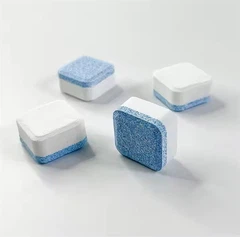
We offer a variety of Coffee Oil Remover Tablets, each designed to meet different customer needs. Our Black and White Coffee Machine Cleaning Tablets are formulated with a specific density that allows for efficient cleaning of a wide range of coffee machines. These tablets are known for their ability to dissolve quickly and effectively remove coffee oils and residues.
Our Coffee Oil Dissolver Tablet has a unique density that is optimized for deep - cleaning. The higher density ensures a concentrated dose of the active ingredients, which can penetrate into the hard - to - reach areas of the coffee machine and break down even the most stubborn coffee oils.
For those who need a more intensive cleaning solution, our Deep Clean Coffee Machine Tablets are the ideal choice. These tablets have a carefully calibrated density to provide a long - lasting and thorough cleaning effect.


Factors Affecting the Density of Coffee Oil Remover Tablets
Several factors can influence the density of Coffee Oil Remover Tablets. The choice of raw materials is one of the most significant factors. Different surfactants, solvents, and fillers have different densities. For example, if we use a high - density filler, the overall density of the tablet will increase.
The manufacturing process also plays a role. The pressure applied during tablet compression can affect the density. Higher compression pressures generally result in tablets with higher densities. Additionally, the moisture content in the raw materials can impact density. If the raw materials have a high moisture content, the tablets may have a lower density, as water is less dense than most of the other components in the tablet.
Conclusion
In conclusion, the density of a Coffee Oil Remover Tablet is a critical parameter that affects its performance, storage, and transportation. As a supplier, we pay close attention to the density of our tablets to ensure that they meet the highest quality standards. Our range of tablets, including the Black and White Coffee Machine Cleaning Tablets, Coffee Oil Dissolver Tablet, and Deep Clean Coffee Machine Tablets, are carefully formulated with the optimal density for effective coffee machine cleaning.
If you are in the market for high - quality Coffee Oil Remover Tablets, we invite you to contact us for more information and to discuss your specific requirements. We are committed to providing the best products and services to our customers, and we look forward to the opportunity to work with you.
References
- "Introduction to Physical Chemistry", Atkins & de Paula, Oxford University Press
- "Handbook of Cleaning Agents", G. M. Cheremisinoff, CRC Press