



Hey there! As a supplier of descaling tablets, I often get asked a lot of questions about how well our products work. One question that pops up quite a bit is, "Do descaling tablets work on copper scale?" Well, let's dive right into it and find out.
First off, let's understand what copper scale is. Copper scale is basically a buildup of minerals and other deposits on copper surfaces. This can happen in a bunch of places, like in water pipes, copper kettles, or even in some industrial equipment where copper parts are used. Over time, this scale can reduce the efficiency of whatever it's on. For example, in a copper kettle, the scale can make it take longer to boil water, and in pipes, it can restrict the flow of water.
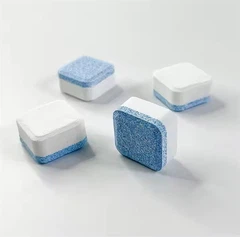
Now, onto our descaling tablets. Our tablets are formulated to break down and remove various types of mineral deposits. They contain a mix of chemicals that react with the scale to dissolve it. But the big question is, do they work on copper scale?
The short answer is, it depends. Copper scale is mainly composed of copper oxides and other mineral salts that can form when copper comes into contact with water and oxygen over time. Our descaling tablets are designed to target common mineral deposits like calcium carbonate, magnesium carbonate, and other hard - water minerals. These are the types of deposits you usually find in kettles, coffee machines, and water heaters.
However, copper scale is a bit different. The chemical composition of copper scale means that it might not react as easily with the chemicals in our descaling tablets as other types of scale. But that doesn't mean our tablets are completely useless against it.
Let's talk about the active ingredients in our descaling tablets. Most of our tablets, like the Oradess Citric Acid Descaler Tablets, contain citric acid. Citric acid is a natural acid that is known for its ability to break down mineral deposits. It works by reacting with the scale to form soluble salts that can be easily washed away.
When it comes to copper scale, citric acid can have some effect. It can react with the copper oxides in the scale to form copper citrate, which is a soluble compound. But the reaction might be slower and less effective compared to when it's dealing with calcium or magnesium - based scale.
Another type of our descaling tablets, the Eco - Friendly Descaler Cleaning Tablets, are made with more environmentally friendly ingredients. These tablets rely on a combination of natural acids and enzymes to break down scale. The enzymes can help to break down the organic matter that might be part of the copper scale, while the acids work on the mineral part.
For copper scale, the enzymes in these tablets can start to break down any biofilm or organic debris that might be attached to the scale. This can make it easier for the acids to access and react with the copper oxides. But again, it might not completely remove the copper scale in one go.
If you're dealing with a coffee machine that has copper parts and is suffering from scale buildup, our Powerful Coffee Machine Descaling Tablet could be a good option. These tablets are formulated to be more powerful and are designed to work specifically on the types of scale that build up in coffee machines.
In a coffee machine, the copper scale might be a combination of coffee oils, mineral deposits, and copper oxides. The powerful formula in these tablets can target all these components. The acids in the tablets can break down the mineral and copper oxide parts of the scale, while other ingredients can help to dissolve the coffee oils.
Now, let's talk about some factors that can affect how well our descaling tablets work on copper scale. The first factor is the thickness of the scale. If the copper scale is very thick, it will be more difficult for the chemicals in the tablets to penetrate and react with it. In this case, you might need to use multiple applications of the tablets or soak the copper part in a solution of the tablets for a longer time.
The second factor is the age of the scale. Older copper scale is often more firmly bonded to the copper surface and might be more resistant to the descaling agents. Newer scale, on the other hand, is usually easier to remove.
The temperature of the solution also plays a role. Higher temperatures can speed up the chemical reactions between the descaling agents and the scale. So, if you're using our tablets to descale a copper part, using warm or hot water can make the process more effective.
So, what can you do if you have copper scale and want to use our descaling tablets? First, make sure to follow the instructions on the package. Usually, you'll need to dissolve the tablet in water to create a descaling solution. Then, soak the copper part in the solution for the recommended amount of time.
If you're dealing with a large or thick layer of copper scale, you might want to try a pre - treatment. You can gently scrub the scale with a soft brush to loosen it up before soaking it in the descaling solution. This can help the tablets work more effectively.


In some cases, you might need to repeat the descaling process a few times to completely remove the copper scale. But don't worry, our tablets are safe to use multiple times on copper surfaces as long as you follow the instructions.
In conclusion, our descaling tablets can have some effect on copper scale, but they might not be as effective as they are on other types of scale. However, with the right approach, such as pre - treatment, using warm water, and repeating the process if necessary, you can achieve good results.
If you're interested in trying our descaling tablets for your copper scale problems or have any other questions about our products, feel free to reach out. We're always here to help you find the best solution for your descaling needs. Whether it's for your home appliances or industrial equipment, we've got the products to keep your copper parts clean and functioning properly.
References
- "Handbook of Mineral Deposits and Their Removal", Mineral Science Press
- "Chemical Reactions of Acids with Metal Oxides", Chemistry Research Journal