

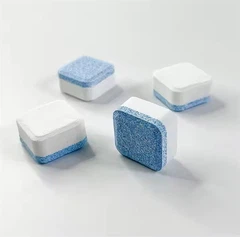


Descaling tablets are a popular solution for keeping our household appliances and containers free from limescale and other mineral deposits. As a supplier of descaling tablets, one question that frequently arises from our customers is, "Do descaling tablets leave any residue?" In this blog, we'll delve into the science behind descaling tablets, examine the factors that can lead to residue, and discuss the measures we take to ensure our products are effective and residue - free.
Understanding Descaling Tablets
Descaling tablets are formulated to break down and remove limescale, which is primarily composed of calcium carbonate and other minerals. These minerals build up over time in appliances such as kettles, coffee makers, and within water bottles due to the presence of hard water. The key ingredients in descaling tablets usually include acids, such as citric acid, which react with the limescale to dissolve it.
For example, when citric acid comes into contact with calcium carbonate (limescale), a chemical reaction occurs. The citric acid (C₆H₈O₇) reacts with calcium carbonate (CaCO₃) to form calcium citrate (Ca₃(C₆H₅O₇)₂), water (H₂O), and carbon dioxide (CO₂). The chemical equation for this reaction is:
3CaCO₃ + 2C₆H₈O₇ → Ca₃(C₆H₅O₇)₂+ 3H₂O + 3CO₂
This reaction effectively breaks down the limescale into soluble compounds that can be easily rinsed away.
Factors That Can Lead to Residue
While descaling tablets are designed to dissolve limescale and leave no residue, several factors can cause residue to be left behind:
1. Incomplete Dissolution
If the descaling tablet does not dissolve completely during the descaling process, it can leave behind undissolved particles. This can happen if the water temperature is too low, as most descaling tablets require warm or hot water to dissolve properly. For instance, if you use cold water to try and descale your kettle with a Bottle Bright Cleaning Tablets, the tablet may not dissolve fully, leaving chunks of the tablet in the kettle.
2. Over - concentration
Using more descaling tablets than recommended can also lead to residue. When there is an excessive amount of the tablet in the water, the chemical reaction may not proceed as efficiently, and some of the ingredients may not react completely with the limescale. This can result in a build - up of unreacted chemicals that can leave a residue. For example, if the instructions for Oradess Citric Acid Descaler Tablets recommend using one tablet for a standard kettle, using two tablets may cause residue problems.
3. Hard Water Minerals
In areas with extremely hard water, there may be a large amount of limescale and other minerals present. If the descaling tablet is not powerful enough to dissolve all of the limescale, some may remain as residue. Additionally, some hard water may contain other minerals that are more difficult to dissolve, such as magnesium silicate, which can resist the action of the descaling tablet and leave behind a stubborn residue.
4. Rinsing Inadequately
Even if the descaling tablet has dissolved and reacted with the limescale properly, inadequate rinsing can leave behind a residue. After the descaling process, it is crucial to rinse the appliance or container thoroughly with clean water to remove all the dissolved limescale and any remaining chemicals from the tablet. If you don't rinse enough, you may notice a film or a taste from the descaling tablet.
Our Approach to Residue - Free Descaling
As a descaling tablet supplier, we are committed to providing products that are effective and leave no residue. Here are the steps we take:
1. High - Quality Ingredients
We source only the highest - quality ingredients for our descaling tablets. Our Limescale Tablets for Kettle are made with pure citric acid and other food - grade additives that are safe for use in household appliances. These ingredients are carefully selected to ensure they dissolve easily and react efficiently with limescale.
2. Precise Formulation
Our research and development team spends a great deal of time formulating our descaling tablets to ensure the right balance of ingredients. We conduct extensive testing to determine the optimal concentration of acids and other components to dissolve limescale effectively without leaving any residue. This means that when you follow the instructions on our product labels, you can be confident that the tablets will work as intended.
3. Clear Instructions
We provide clear and detailed instructions on our product labels. These instructions include information on the appropriate water temperature, the correct number of tablets to use based on the size of the appliance or container, and the recommended rinsing procedure. By following these instructions, our customers can minimize the risk of residue.
4. Testing and Quality Control
Before our descaling tablets are released to the market, they undergo rigorous testing. We test them in various conditions, including different water hardness levels and temperatures, to ensure they dissolve completely and leave no residue. Our quality control team checks each batch of tablets to ensure they meet our high standards.
Case Studies
To illustrate the effectiveness of our descaling tablets in leaving no residue, let's look at a few case studies:
Case Study 1: Kettle Descaling
A customer in a hard - water area used our Limescale Tablets for Kettle to descale their kettle. They followed the instructions carefully, using one tablet in hot water and allowing it to sit for the recommended time. After thorough rinsing, they found that the kettle was completely free of limescale and there was no residue left behind. The water boiled as normal, and there was no strange taste or smell.
Case Study 2: Water Bottle Cleaning
Another customer used our Bottle Bright Cleaning Tablets to clean their water bottle. The bottle had a thick layer of limescale on the inside. After using the tablet in warm water and rinsing several times, the limescale was removed, and the bottle was left clean and odor - free. There was no visible or detectable residue.
Conclusion
In conclusion, while descaling tablets have the potential to leave residue under certain circumstances, our products are designed to minimize this risk. By using high - quality ingredients, precise formulations, and providing clear instructions, we ensure that our descaling tablets dissolve limescale effectively and leave no residue.
If you have any questions about our descaling tablets or are interested in purchasing them for your home or business, we encourage you to reach out to us. We are always happy to discuss your specific needs and help you find the right descaling solution. Whether you are dealing with a kettle full of limescale or a water bottle that needs a good clean, our descaling tablets are up to the task. Contact us today to start a procurement discussion and experience the difference of residue - free descaling.


References
- Atkins, P., & de Paula, J. (2006). Physical Chemistry. Oxford University Press.
- Housecroft, C. E., & Sharpe, A. G. (2008). Inorganic Chemistry. Pearson Education.